



Most advice on Perfect Amino vs BCAA starts with the bottle. That's backward. The first question isn't which amino product “wins.” It's whether your diet already gives your body what it needs to build and repair muscle.
That changes the whole debate.
BCAAs became popular because they're simple and easy to market: three amino acids, workout-friendly flavors, and a strong association with training. Perfect Amino takes the opposite pitch. It presents itself as a fuller essential-amino-acid product and leans hard on efficiency claims. Both approaches sound compelling until you ask the question most supplement guides skip: Are you already eating enough total protein?
If the answer is yes, amino supplements often move from “performance tool” to “expensive flavored insurance.” If the answer is no, the comparison matters a lot more, because then the difference between a partial amino profile and a complete essential-amino-acid profile becomes practical, not theoretical.
A good coach doesn't judge supplements in isolation. He judges them against the athlete's diet, training schedule, appetite, and constraints. A lifter who eats enough protein across the day has a very different need profile than a vegan athlete, someone dieting hard, or someone training fasted before breakfast.
That's the frame that makes this topic useful. Not hype. Not label claims. Context.
Table of Contents
- Introduction The Amino Acid Debate You Might Be Missing
- Amino Acids 101 Understanding EAAs vs BCAAs
- Perfect Amino vs BCAAs A Head-to-Head Comparison
- The Real Deciding Factor Your Total Protein Intake
- Practical Dosing Timing and Protocols for Your Goals
- Stacking Safety and Reading Supplement Labels
- Frequently Asked Questions About Amino Acids
Introduction The Amino Acid Debate You Might Be Missing
The loudest argument in this category is wrong in a subtle way. People argue about whether BCAAs beat Perfect Amino for muscle growth, recovery, and workout performance. The better question is whether either one adds anything meaningful on top of your current nutrition.
That matters because BCAAs and EAA-style products don't play the same role. One is a subset. The other is designed to be a complete essential-amino-acid formula. On paper, that makes the EAA-style option more complete. In real life, the value of that completeness depends on what else you ate that day.
A strength coach sees this every week. One client is under-eating protein, training hard, and trying to recover on convenience foods. Another is already hitting protein targets from meals and shakes. If both buy the same amino product, one may be plugging a real gap while the other is just adding another scoop to an already-covered plan.
Practical rule: Don't judge an amino supplement by its label alone. Judge it by what problem it solves in your diet.
Perfect Amino also brings a second issue into the conversation. It isn't just “EAAs vs BCAAs.” It's also transparent dosing vs hidden dosing. That matters when you're trying to compare products properly instead of grading ad copy.
So the useful version of the debate looks like this:
- If protein intake is low or inconsistent, a full essential-amino-acid product may make more sense than BCAAs alone.
- If protein intake is already sufficient, the practical upside of either product may be limited.
- If a label hides exact amino doses, it becomes harder to evaluate whether the formula is strong or merely well marketed.
That's the lens that clears up the noise around Perfect Amino vs BCAA.
Amino Acids 101 Understanding EAAs vs BCAAs
The first mistake in this debate is treating BCAAs and EAAs as competing categories. They are not. BCAAs sit inside the EAA category.
EAAs are the nine amino acids your body cannot make on its own, so you have to get them from food or supplements. BCAAs are three of those nine: leucine, isoleucine, and valine. They matter, especially for training, but they do not cover the full list required to build new muscle protein.
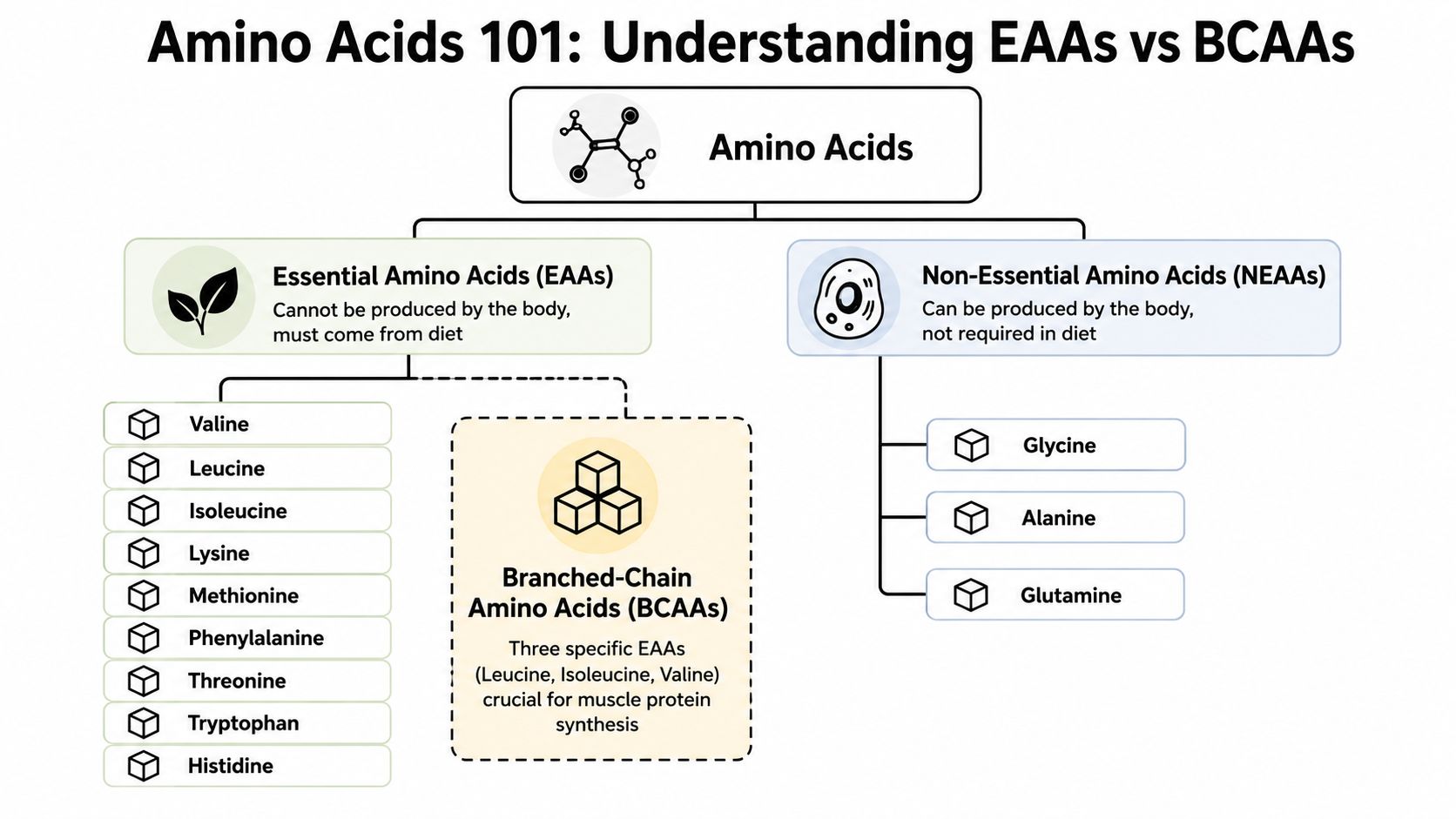
If you want a broader primer on how these categories fit together, the RxGainz amino acids guide covers the full classification.
That distinction matters because muscle protein synthesis has two separate requirements. You need a trigger, and you need enough substrate to finish the job. Leucine is the best-known trigger, which is why BCAA products have stayed popular for so long. But triggering muscle protein synthesis is not the same as supplying all the amino acids needed to sustain it.
A BCAA drink can raise the signal. An EAA formula is built to provide the full set of dietary amino acids required for that process.
Why lifters get this wrong
Supplement marketing usually centers on what sounds most anabolic in isolation. Leucine gets the spotlight because it has a clear mechanistic role in signaling. That part is real. The problem is what gets left out. If the rest of the essential amino acids are missing, the body still has to pull them from somewhere else, usually recent meals or existing amino acid pools.
That is why context matters more than the label headline. If someone ate a solid protein meal before training, a BCAA product may be redundant because the missing amino acids are already available. If someone trains fasted or consistently under-eats protein, a full EAA product makes more physiological sense than BCAAs alone.
Here is the practical breakdown:
| Supplement type | What it includes | Main limitation |
|---|---|---|
| BCAA product | Leucine, isoleucine, valine | Does not provide all essential amino acids needed for complete muscle protein synthesis |
| EAA product | All nine essential amino acids in many formulations | Formula quality varies, and some products hide exact doses |
Leucine helps start the process. Full EAA formulas are designed to support the whole process.
This is also why “Perfect Amino vs BCAA” can confuse buyers. The fair comparison is not three amino acids versus nine amino acids in a vacuum. The better question is whether your daily diet already covers the amino acids the supplement is trying to provide.
Perfect Amino vs BCAAs A Head-to-Head Comparison
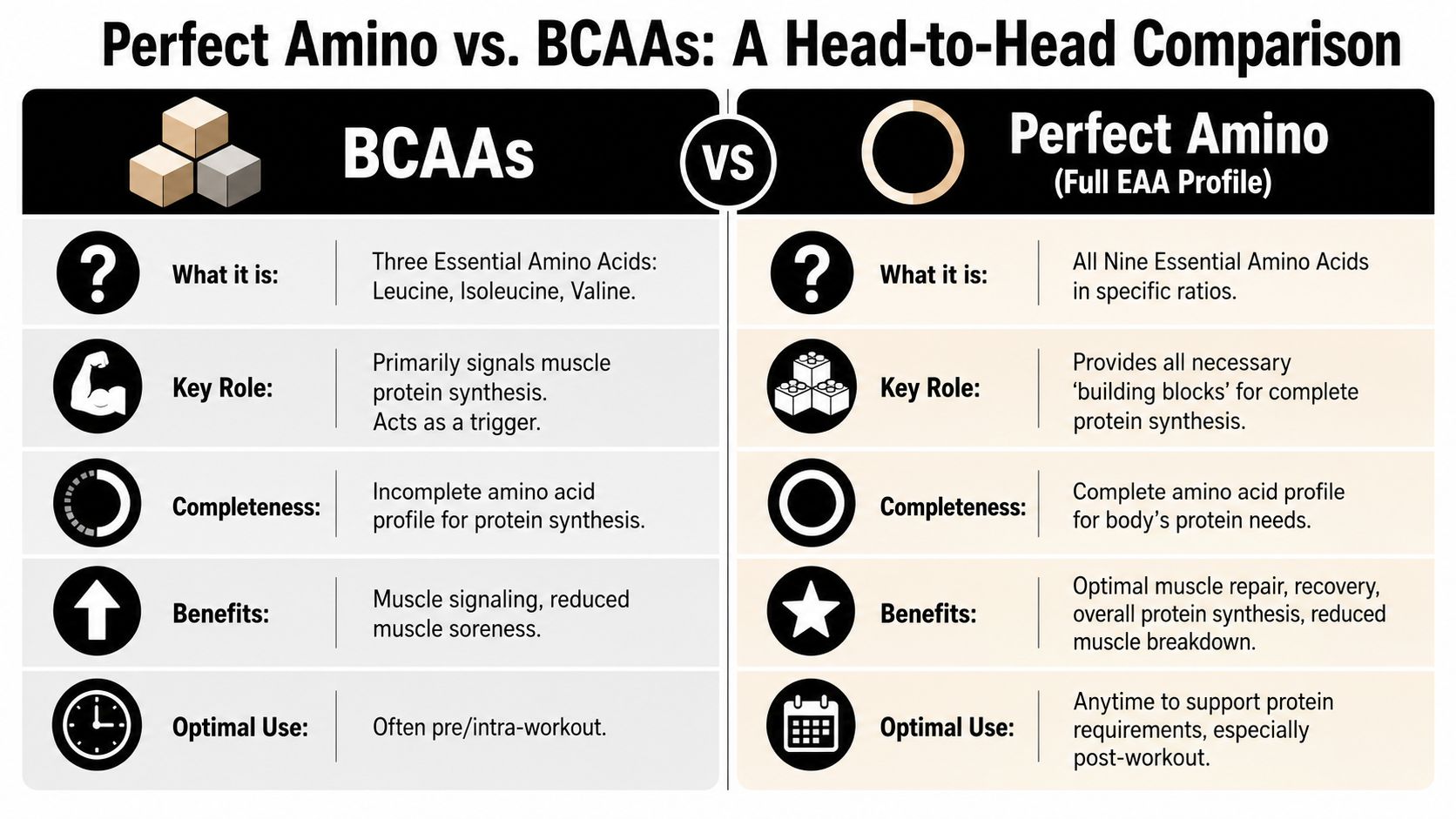
A fair comparison starts with job description, not branding.
BCAAs are a narrow tool. They supply leucine, isoleucine, and valine, which are involved in signaling and energy metabolism during training. Perfect Amino is sold as a broader essential amino acid formula, so the comparison is incomplete signaling support versus a more complete amino acid profile. If you want a quick refresher on the category itself, RxGainz's guide to BCAA supplements summarizes where these products fit and where they fall short.
That difference matters because these products are not solving the same problem. A BCAA powder is usually aimed at workout support. An EAA product such as Perfect Amino is marketed more like a low-volume substitute for part of a protein feeding. Those are different use cases, and they should be judged by different standards.
Here's the embedded comparison video for a visual walk-through:
Where the comparison gets distorted
Perfect Amino often gets attention because of BodyHealth's own marketing claims about very high amino acid utilization and extremely low caloric impact on its official product materials. Treat those numbers as brand claims first, not settled independent evidence.
That does not prove the product is ineffective. It changes the burden of proof. If a company makes an unusually strong efficiency claim, the label and the supporting evidence should be unusually clear.
Label transparency is where this head-to-head gets more practical. BCAA products are usually easy to read because there are only three amino acids to disclose. Perfect Amino style products can be harder to evaluate if the formula presentation makes it difficult to see how much of each amino acid you are getting per serving. Without clear dosing, “full spectrum” sounds better than it can be verified.
Use this filter when comparing products:
| Question | BCAA products | Perfect Amino style EAA products |
|---|---|---|
| Provides all amino acids needed for complete muscle protein synthesis | No | Usually marketed as yes |
| Simple to classify | Yes | Depends on the exact formula |
| Easy to assess from the label | Usually yes | Not always |
| Best fit | Narrow training support role | Situations where a fuller amino profile may help |
One practical conclusion follows. If a product gives you only three amino acids, it is a specialist tool. If a product claims to act like a highly efficient protein substitute, you should expect much stronger label clarity and much stronger evidence before paying a premium.
So the honest comparison is straightforward. BCAAs are simpler, cheaper, and narrower. Perfect Amino is broader in concept, but the formula and the evidence behind the claims matter more than the category name on the tub.
The Real Deciding Factor Your Total Protein Intake
Supplement debates get distorted when the base diet is ignored. For lifters who already eat enough high-quality protein across the day, Perfect Amino and BCAA products often compete for a problem that has already been solved.
That is the context many labels skip.
Research reviews on protein intake and resistance training consistently point in the same direction. Daily protein intake is the main driver, while isolated amino acids have less room to add value once total intake is already adequate. If you need a refresher on how to set up that foundation, start with this guide to daily protein intake for performance and muscle gain.
When supplementation is mostly redundant
A complete protein feeding already supplies the essential amino acids needed to support muscle protein synthesis. That matters because BCAAs provide only three amino acids, and even a full EAA product is still trying to improve on a diet that may already be doing the job.
In practice, a lifter eating enough protein from meals, shakes, or both usually gets more from consistency than from adding another flavored intra-workout product.
A stronger evidence-based summary comes from the broader sports nutrition literature, not a podcast clip or a YouTube argument. Position stands and review papers from sports nutrition researchers have repeatedly concluded that total daily protein, plus sensible meal distribution, explains far more of the adaptation story than specialty amino products do in well-fed athletes.
That should change how you spend money. If your protein target is covered, amino supplements shift from high-priority purchase to convenience item.
When amino supplements can justify the cost
They still have uses. Just narrower ones than the marketing suggests.
Amino supplements make the most sense when protein intake is inconsistent, low, or hard to execute with normal food. Common examples include:
- Low-appetite phases where full meals feel heavy or impractical
- Plant-based diets that need more deliberate amino acid planning
- Fasted training when you want a small pre- or intra-workout option
- Travel or chaotic workdays that make regular protein feedings unreliable
Here is the practical order of operations a good coach would use:
- Audit total daily protein first.
- Fix obvious gaps with food or a standard protein powder.
- Use a full EAA product if you still need a small-volume amino option.
- Use BCAAs only if you understand that they are a narrow tool, not a substitute for complete protein.
Adequate daily protein solves more training nutrition problems than any amino tub.
That is the point missing from much of the Perfect Amino vs BCAA debate. Once protein intake is already handled, the difference between these products gets smaller. If protein intake is not handled, both products become secondary to fixing the diet.
Practical Dosing Timing and Protocols for Your Goals
How to choose the right protocol
The smart way to use amino supplements is to match them to a specific constraint. Don't start with the serving scoop. Start with the job the supplement needs to do.
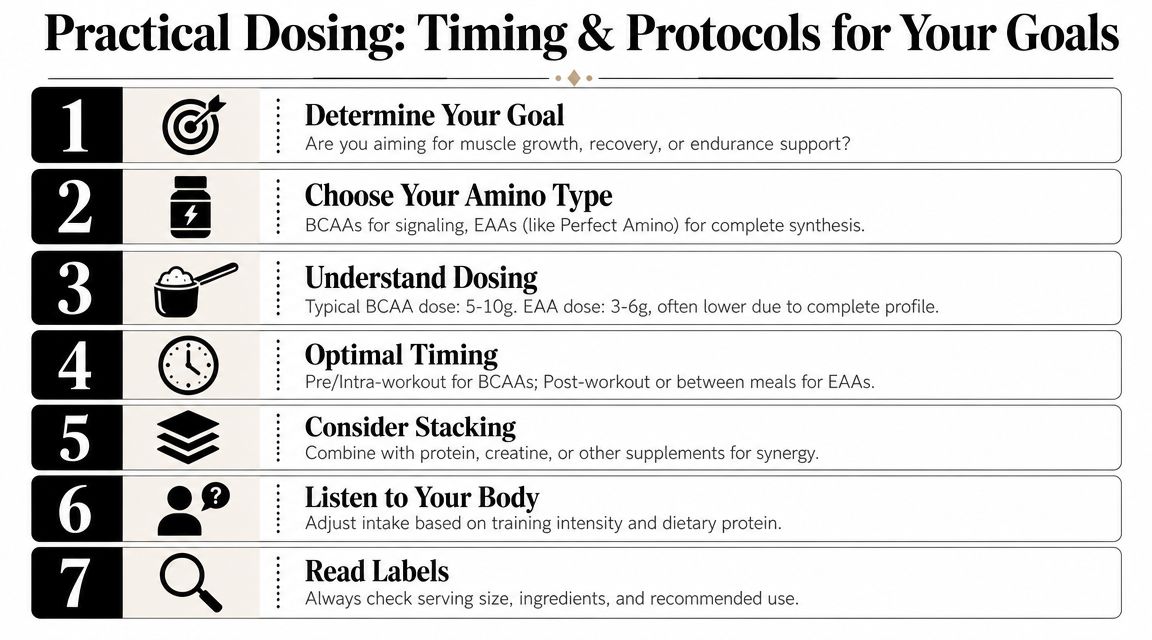
The visual above lists typical supplement-label ranges, but practical use still comes down to context. Since precise evidence-based dosing numbers beyond the provided label-style ranges aren't verified here, the safest advice is to use the product's own serving guidance, then judge whether the supplement is solving a real nutrition problem.
A clean process looks like this:
- Define the goal. Muscle gain, recovery support, fasted training, or convenience.
- Check your meals first. If you can eat protein before or after training, that may cover the same need.
- Pick the category. Choose a full EAA product when you need broader amino coverage. Choose BCAAs only when you specifically want a narrow workout-time product and understand its limits.
- Follow the label. Stick to labeled serving directions unless a qualified clinician or sports dietitian gives you a different protocol.
Goal-based use cases
Different athletes use these products for different reasons. The category matters less than the context.
Bodybuilder in a calorie deficit
A full EAA product can make more sense than BCAAs if meals are spaced far apart or appetite is low. The point isn't magic. The point is keeping essential amino acid intake more consistent when food intake gets messy.Endurance athlete during long sessions
Some athletes like BCAAs during training because they're light and easy to sip. That can be fine as a preference play. But if the broader goal is recovery support, a complete EAA product or actual post-training protein usually makes more physiological sense.Fasted morning lifter
This is one of the clearest use cases for EAAs. If you don't want a full meal before training, a complete essential-amino-acid product can serve as a lighter bridge.High-protein lifter already eating well
Skip both unless convenience is the deciding factor. Spend the money elsewhere.
A few practical notes help keep expectations realistic:
| Situation | Better fit | Reason |
|---|---|---|
| Fasted training | EAA style product | More complete amino coverage |
| Already eating enough protein | Usually neither | Likely redundant |
| Workout drink preference | BCAA can fit | Convenience and taste, not completeness |
| Protein gaps between meals | EAA style product | Better aligned with whole protein support |
If you're comparing forms, powders usually make more sense for workout use because they're easier to drink around training. Capsules can work for travel or simplicity, but they're less practical if you want a meaningful serving from multiple capsules.
For athletes building a broader supplement routine, this guide on combining Perfect Amino with creatine shows how people often place amino products alongside more established staples.
Stacking Safety and Reading Supplement Labels
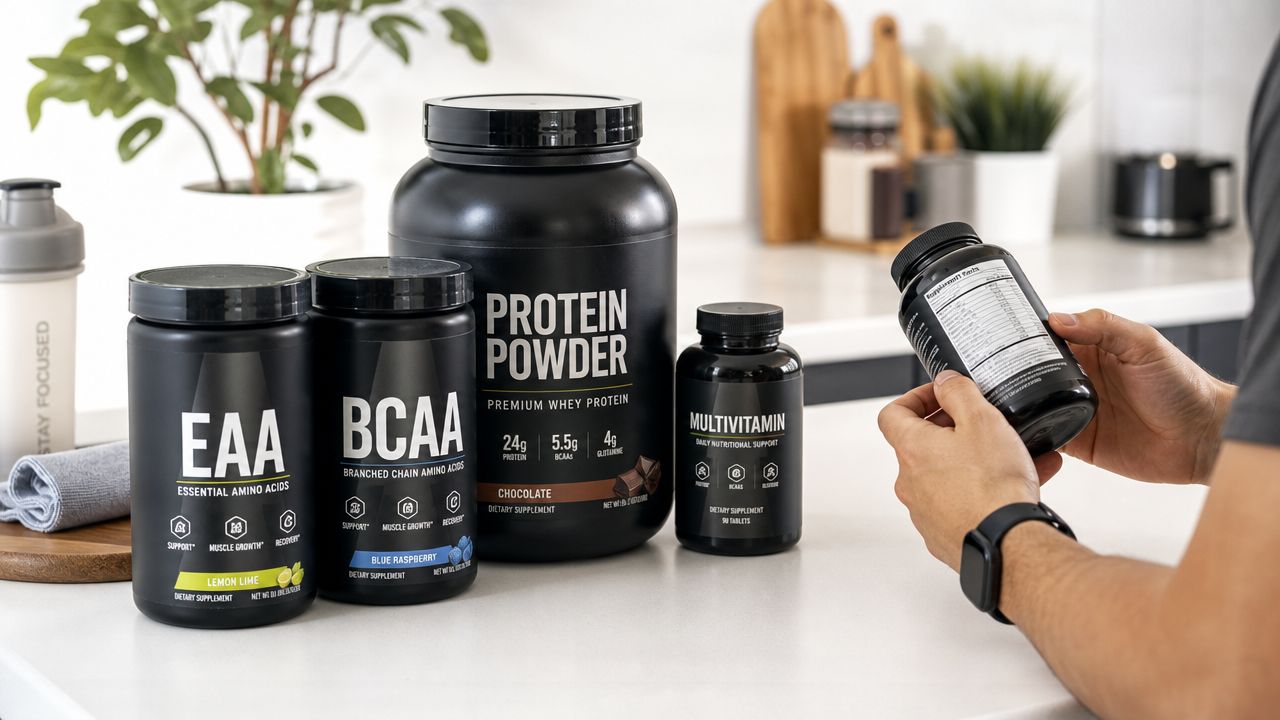
How to stack without wasting money
Most stacking mistakes come from overlap. Lifters buy whey, an EAA formula, a BCAA powder, and a recovery blend, then assume more labels means more recovery. Often it means they're paying four times for the same general purpose.
A cleaner stack is built around roles:
- Protein powder handles total intake when whole food falls short.
- Creatine sits in a different category and doesn't replace protein or amino acids.
- EAA or BCAA products should be added only if there's a clear timing or intake gap.
That means the safest “stack” for most gym-goers is boring. Food first. Protein if needed. Then decide whether training timing or appetite justifies amino support.
What to check on the label
A key concern with some EAA products, including Perfect Amino as described in reviews, is the use of a proprietary blend, which hides the specific dose of each amino acid and makes it difficult to verify whether important components like leucine appear at an effective level, according to Innerbody's Perfect Amino review.
That matters more than flashy copy. If the label doesn't tell you how much of each amino acid you're getting, you can't compare formulas intelligently.
Use this checklist:
- Transparent amino listing. Look for each amino acid named with a specific amount, not just a blend total.
- Clear intended use. A product should tell you whether it's built for workout sipping, meal gaps, or general amino support.
- Minimal filler logic. If the label reads like a kitchen sink, ask why every add-on is there.
- Independent quality signals. Third-party testing and clear manufacturing standards help reduce guesswork.
If you want a broader framework for vetting products, this RxGainz guide on checking whether a supplement is legit walks through common red flags.
A transparent label doesn't guarantee a great product. A hidden label makes a great product harder to prove.
Frequently Asked Questions About Amino Acids
Below is a quick-reference table addressing questions many individuals still have after comparing Perfect Amino vs BCAA.
| Question | Answer |
|---|---|
| Is Perfect Amino the same thing as an EAA supplement? | It's marketed as an EAA-style product rather than a BCAA-only product. The key issue is not just category, but whether the label clearly discloses the amount of each amino acid. |
| Are BCAAs useless? | Not useless. Just limited. They provide only three essential amino acids, so they don't offer the complete amino acid profile needed for full protein synthesis on their own. |
| If I already drink whey protein, do I need either one? | Usually not. If your total daily protein is already covered, amino supplements often become optional convenience products. |
| Who is most likely to benefit from an EAA product? | People with inconsistent protein intake, lower-protein diets, vegan diets, low appetite, or fasted training routines are the clearest candidates. |
| Can I take BCAAs during training and still eat protein later? | Yes. That can fit a routine. The key is understanding that the later protein meal is doing much of the heavy lifting for complete amino intake. |
| What's the biggest red flag on an amino label? | A proprietary blend. If exact amino doses are hidden, you can't properly compare the product to other formulas. |
| Should I choose powder or capsules? | Powder is usually more practical around workouts. Capsules are more convenient for travel or for people who don't want to mix drinks. |
| What should I buy first if my budget is limited? | Fix total daily protein first. That usually matters more than choosing between BCAAs and a branded EAA formula. |
The shortest honest answer is this: Perfect Amino is the more logical category choice than BCAAs if you need amino supplementation, but neither deserves automatic purchase if your daily protein intake is already solid.
That's the part most marketing avoids, because it shrinks the category. It's also the part that saves you money.
If you want more no-hype breakdowns on supplements, label transparency, recovery tools, and evidence-based performance nutrition, visit RxGainz. The site focuses on practical buying decisions, clear explanations, and the kind of context that helps you stop paying for overlap.
