



If two athletes follow the same program, eat the same macros, and recover with similar discipline, why does one thrive while the other stalls? A DNA fitness test tries to answer that question. Not by handing you a perfect plan, but by offering clues about how your body may tend to respond to training, recovery, and nutrition.
That distinction matters. Many consumers purchase these tests hoping for prescriptions. The better use is much narrower and more practical. Use the report to generate smarter training hypotheses, then check those ideas against how your body responds in the gym, on the track, and during recovery.
Table of Contents
- Understanding the DNA Fitness Test Framework
- The Science Behind Your Genetic Blueprint
- How to Choose a Reputable DNA Test Provider
- How to Interpret Your Results for Smarter Training
- Limitations and Privacy Risks You Must Understand
- Frequently Asked Questions About DNA Fitness Tests
Understanding the DNA Fitness Test Framework
A DNA fitness test is usually a consumer wellness product, not a medical diagnostic. That sounds like a legal technicality, but it changes how you should read the results. You're not getting a diagnosis. You're getting a report that estimates predispositions related to exercise response, recovery, and nutrient handling.
The category became commercially relevant when genetic testing moved from broad screening toward consumer-focused wellness testing, with companies packaging trait-based insights around training personalization rather than disease alone, a shift described in Mayo Clinic's overview of genetic testing. That's why most reports talk about metabolism, endurance, recovery, and injury tendencies instead of clinical disease management.
What the process usually looks like
The workflow is simple:
- Collect a sample using saliva or a cheek swab.
- Mail it to a lab for genotyping.
- Receive a digital report that translates selected genetic variants into practical categories.
If you already use other forms of athlete monitoring, this fits into the same broader ecosystem as performance testing and diagnostics tools. The difference is that DNA isn't telling you what happened this week. It's trying to estimate longer-term biological tendencies.
Practical rule: Treat the sample as easy to collect, but treat the interpretation as complicated.
What these reports are actually trying to do
Most providers frame the output around questions like these:
- Training response: Might you respond better to more endurance-oriented work or more power-oriented work?
- Recovery profile: Do you appear more sensitive to inflammation, tissue stress, or slower recovery patterns?
- Nutrition handling: Might certain macro strategies or supplement approaches deserve closer testing?
That sounds concrete. In reality, it isn't a command. It's a starting point.
Mayo Clinic also warns that direct-to-consumer genetic results don't always give clear answers and shouldn't be used alone for medical decisions, which is the right mindset to carry into fitness use as well. For training, the report is best seen as a context layer. It may help you ask better questions, but it doesn't replace programming skill, performance testing, or common sense.
The Science Behind Your Genetic Blueprint
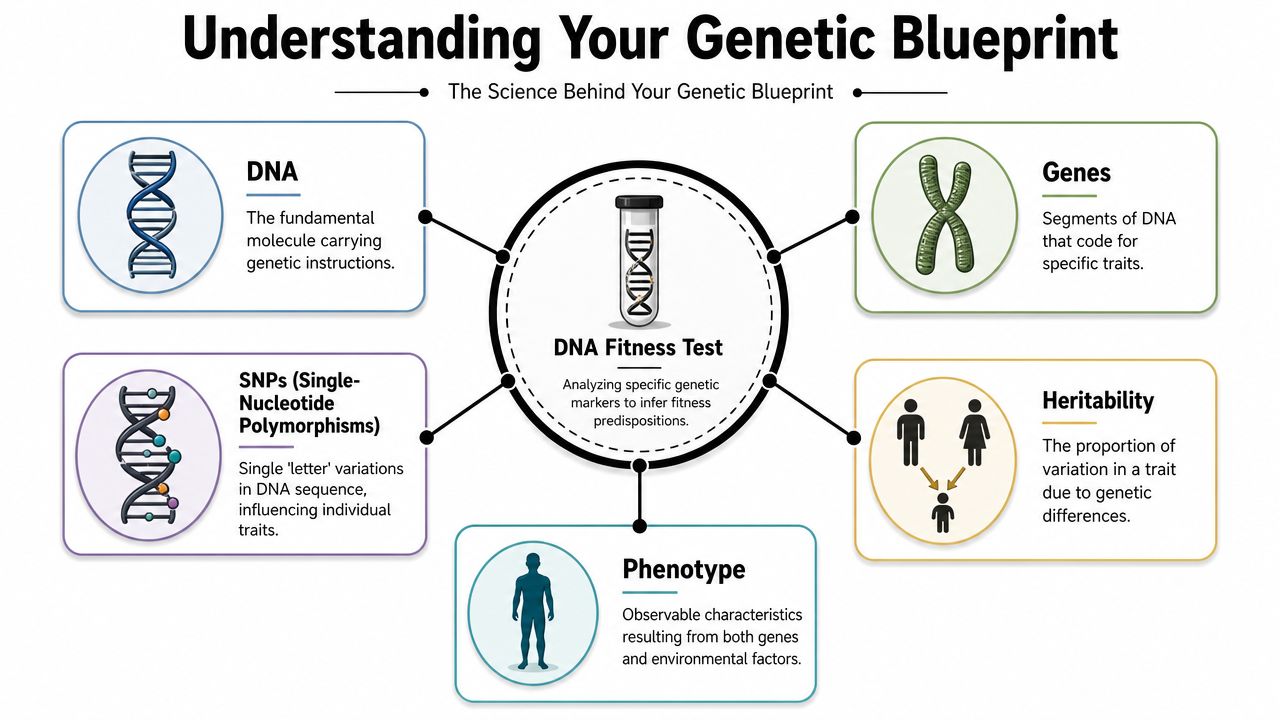
Genes influence performance, but they rarely do it in a clean, one-gene-one-outcome way. That's where readers often get lost. A DNA fitness test isn't usually finding one master switch for "good at endurance" or "bad at recovery." It's stacking many small signals into a profile.
Why single genes rarely tell the whole story
The key building blocks are often SNPs, or single-nucleotide polymorphisms. Think of them as tiny spelling differences in your DNA. One SNP may slightly shift how strongly you tend toward a trait, but that effect is usually modest.
A useful analogy is an engine map. One setting might change throttle response a little. Another affects fuel use a little. Another influences heat management. No single setting fully determines how the car performs. The final result depends on the combination, plus the driver, road, weather, and maintenance. Human performance works the same way.
Evergreen Life explains that the field has advanced because researchers have identified "a number of genes and variations" linked to areas like endurance, muscle strength, fat burning, and recovery. It also notes that FitnessGenes offers 180+ reports across 14 health and fitness categories, which shows how companies build consumer products by aggregating many small trait-level outputs rather than one definitive score, as described in Evergreen Life's guide to DNA fitness testing.
What polygenic really means for athletes
For a data-driven athlete, the most important word is probabilistic.
Your report may suggest that your biology leans a certain way. It doesn't mean your training history, sport demands, sleep quality, body composition, or technical skill suddenly stop mattering. It means the test is offering weighted probabilities, not certainties.
A few practical translations help:
| Genetic concept | Plain-English meaning | Training takeaway |
|---|---|---|
| Gene | A section of DNA tied to biological functions | Interesting, but rarely enough on its own |
| SNP | A tiny DNA variation | Usually a small nudge, not a verdict |
| Polygenic trait | A trait shaped by many variants | Expect tendencies, not clear predictions |
| Phenotype | What you actually show in the real world | Your testing and training data still matter more |
If you like reading studies and training logs, a report can be a useful companion to broader fitness research and evidence summaries. But don't confuse "scientific-looking" with "fully settled." The science behind these reports has a real basis. The leap from association to actionable programming is where caution starts.
Your DNA sets constraints and possibilities. Your training determines how much of either becomes visible.
How to Choose a Reputable DNA Test Provider
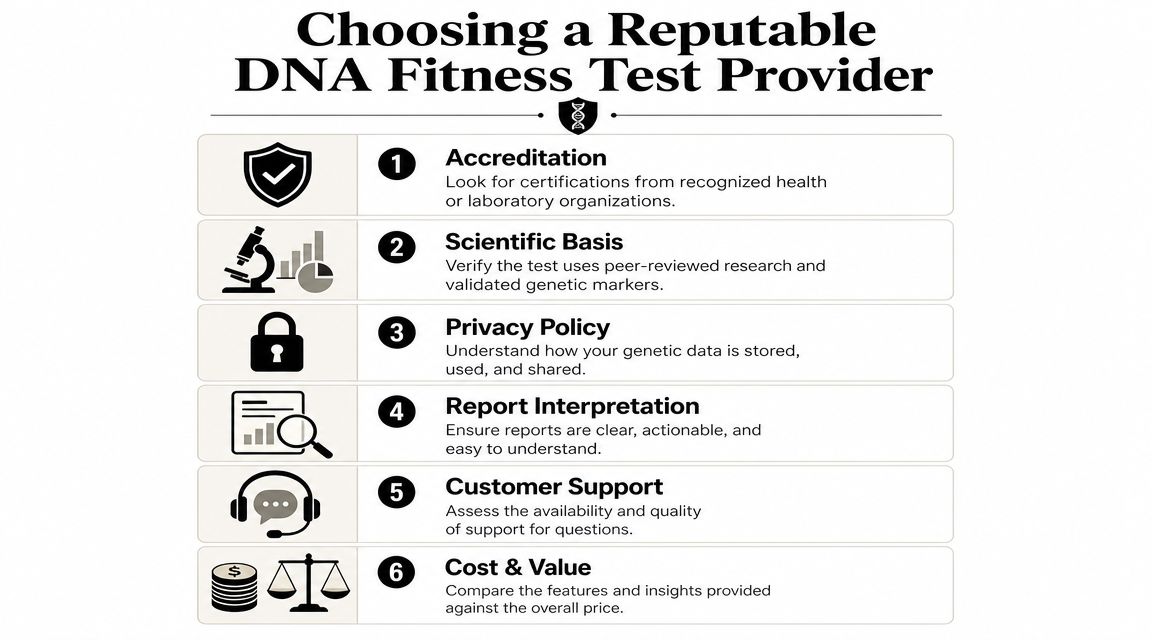
Most test providers look similar at first glance. They all promise personalized insight. The important differences are usually buried in the lab details, privacy policy, and report quality.
The three checks that matter most
Neutral guidance suggests checking whether the lab is CLIA-certified, how many genes are assessed, and whether the interpretation layer adds value. It also notes that some products may provide more information than consumers can realistically use, as discussed by CircleDNA's overview of genetic testing considerations.
That gives you a clean screening framework:
- Lab credibility: If the company doesn't clearly state lab standards, that's a problem.
- Analytical depth: A longer report isn't automatically better, but you should know what is being assessed.
- Interpretation quality: Raw genetic data isn't useful if the report turns into vague lifestyle filler.
What to read before you buy
Open the privacy policy before you open your wallet. You want to know what happens to your genetic data, whether it can be shared, whether you can request deletion, and what rights you keep after submission.
A reputable buyer's checklist looks like this:
- Check the lab first. Look for clear mention of CLIA certification if the company operates in that framework.
- Read the privacy terms in full. Genetic data is more sensitive than a normal app login or nutrition survey.
- Scan for overpromising language. "Best workout for your genes" is marketing. Good providers usually sound more careful.
- Look at sample reports. You want explanations, not just colored scores.
- Compare with purpose. A broad package may sound attractive, but if you only want training-relevant insights, feature overload can make the report less useful.
If you're comparing options side by side, a tool like this testing kit comparison resource can help you organize the practical differences. The goal isn't to find the most impressive dashboard. It's to find a provider whose methods and reporting style support good decision-making.
A report becomes valuable when it helps you change one training or nutrition variable intelligently, then verify the result.
How to Interpret Your Results for Smarter Training
At this point, a DNA fitness test either becomes useful or becomes expensive entertainment. The right question isn't, "What does my report say about me?" The right question is, "What should I test next because of this report?"
Product descriptions show that the most actionable output is a risk-weighted profile, not a single ideal plan. For example, the ACTN3 gene is commonly used to infer sprint or power tendency, while the ACE gene is frequently included in endurance-oriented interpretations. The best use case is as a secondary input alongside training history and performance testing, as outlined in GeneTrace's physical fitness DNA test description.
Start with tendencies, not labels
Don't read "power leaning" and conclude you're built only for heavy triples. Don't read "endurance leaning" and assume max strength work is wasted on you. Those are category errors.
Instead, turn each result into a coaching question:
- If a report leans toward power-oriented traits, do you progress faster with lower-rep work and longer rest periods?
- If a report leans toward endurance-oriented traits, do you tolerate higher weekly volume better than your peers?
- If the report flags recovery or injury susceptibility, do you need more conservative loading progressions or better tracking of soreness and session quality?
A good report narrows your testing priorities. It shouldn't shrink your identity as an athlete.
Turn the report into training experiments
Use a simple framework: If the report says X, test Y, then measure Z.
Here are examples that keep the science grounded:
| If the report suggests | Test in training | Measure in real life |
|---|---|---|
| Greater sprint or power tendency | Run a block with more explosive lifts, lower rep ranges, and more rest | Bar speed, jump performance, quality of later sets |
| Greater endurance orientation | Increase volume tolerance gradually or add longer aerobic work | Pace stability, heart-rate recovery, weekly fatigue patterns |
| Higher injury susceptibility | Add slower progressions, movement prep, and stricter recovery monitoring | Missed sessions, pain flare-ups, perceived joint stress |
| Slower recovery tendency | Space hard sessions more carefully | Session RPE trends, soreness duration, sleep consistency |
That's the whole game. Convert a genetic suggestion into a testable intervention.
If you want to apply this logic to nutrition and supplements, the same method works. Instead of buying more products because your report sounds advanced, use genetics-informed supplementation frameworks to decide which variables are worth testing.
Use supplements the same way
Supplements are where people often overreact to DNA reports. The smarter move is to stay conservative.
If a report hints at nutrient handling differences or recovery-related tendencies, don't build a giant stack overnight. Change one variable at a time. Keep the outcome measurable. Look for effects on training quality, recovery perception, or consistency, not just a more personalized story.
A useful review before you apply these ideas is below.
Coaching lens: A DNA report should help you design better experiments. If it replaces experimentation, you're using it wrong.
Limitations and Privacy Risks You Must Understand
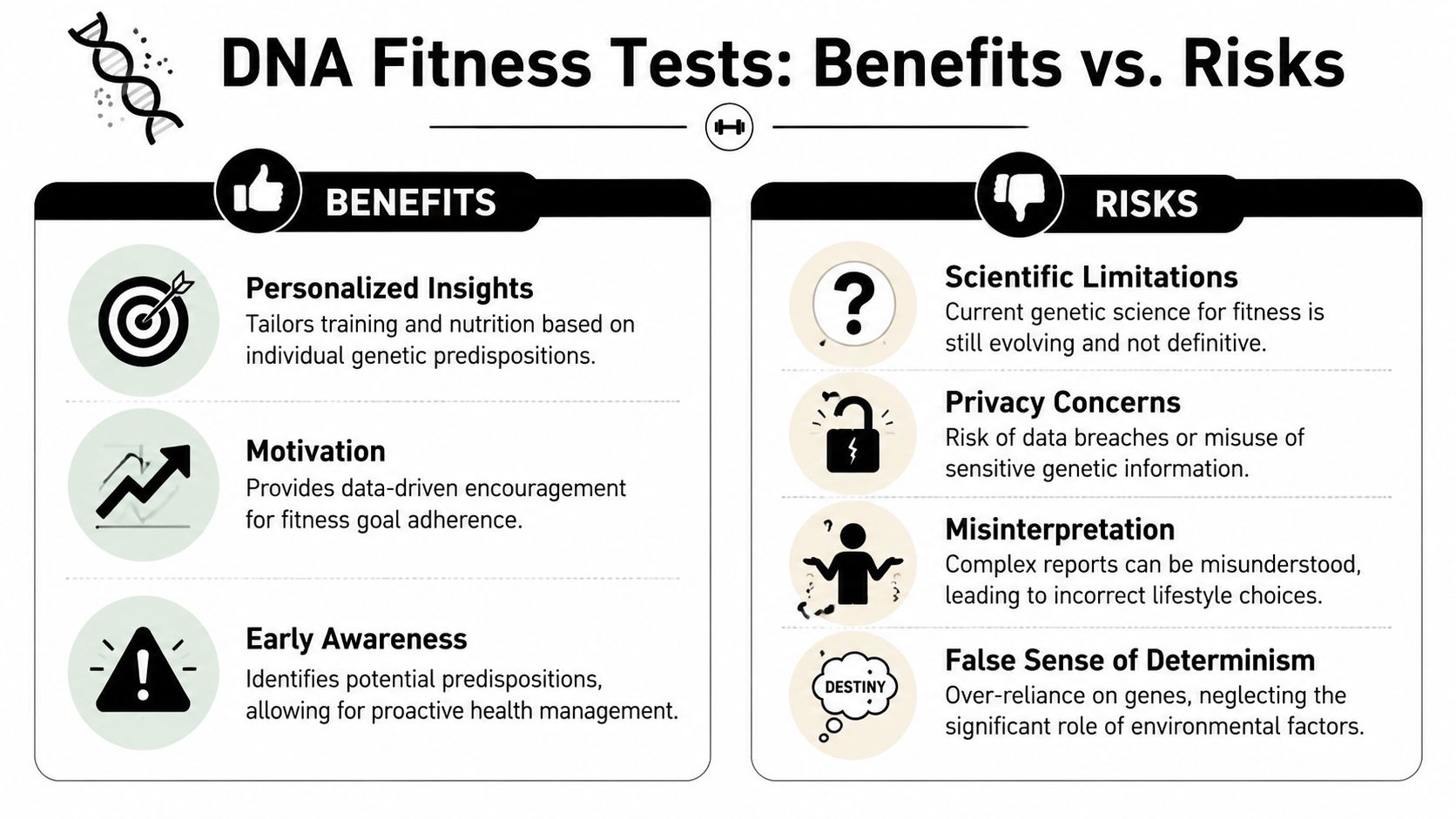
The biggest problem with DNA fitness testing isn't that the idea is absurd. It's that many companies sell a level of certainty the science doesn't support.
The evidence problem
One of the most important practical questions is whether these tests change outcomes beyond what a solid standard training plan already delivers. That's where the confidence level drops fast.
Independent reporting has described the fitness-genetics industry as resting on "very shaky" evidence, and broader overviews warn that consumer tests may overstate how much they can personalize training, as summarized in Healthline's review of DNAfit and the wider category. That doesn't mean every result is useless. It means the burden of proof shifts to you and your own data.
So if a report suggests a new direction, validate it with objective measures over time:
- Track performance markers such as pace quality, lifting quality, or repeatability.
- Watch recovery signals like perceived readiness, soreness duration, and consistency.
- Keep a baseline plan in mind so you can tell whether the DNA-informed adjustment helped.
The privacy problem
Genetic data is different from a normal wellness questionnaire. You can't rotate it like a password. Once it's out, it's out.
Before buying, ask practical questions:
- Who stores the data?
- Can the company share or transfer it?
- Can you request deletion?
- Do you keep access to raw data, or only their interpretation?
- Will they use your sample for research or product development?
If you're already building a more data-driven fitness system, treat genetics as the most sensitive layer of the stack. Training logs are personal. DNA is permanent.
The best safeguard is selective participation. If the privacy terms feel fuzzy, skip the test.
Frequently Asked Questions About DNA Fitness Tests
Is a DNA fitness test the same as a medical genetic test
What question is this test trying to answer? A medical genetic test looks for disease risk, diagnosis, or treatment guidance under clinical standards. A DNA fitness test is a wellness product. It usually comments on tendencies related to training response, recovery, or nutrient handling, and it should not replace medical care or clinical decision-making.
How is the sample usually collected
Most companies use a saliva sample or cheek swab. The process is simple, noninvasive, and usually done at home. From a lab standpoint, they only need enough DNA to read selected markers.
How long does it take to get results
Turnaround time is often about 2 to 4 weeks, based on ISSA's overview of DNA testing for health and wellness. Some providers move faster, some slower. Check the company timeline before ordering, especially if you want results before a training block starts.
How many genes or markers do these tests analyze
It varies by provider. Some companies analyze a relatively small set of fitness-related markers, while others wrap broader coaching claims around the same kind of raw genetic inputs. MedlinePlus explains an important point here: the number of variants tested does not, by itself, tell you how useful the report will be.
For training, the better question is, "Do these markers lead to testable decisions?" A panel with fewer markers can still be useful if it helps you form a clear hypothesis, such as whether you should compare higher-volume work against higher-intensity work over the next 8 to 12 weeks.
Should I retest later
Usually, no. Your inherited DNA sequence is stable for this purpose. What can change is the interpretation. As research improves, a company may revise what a marker means, which is more like getting an updated software layer than getting a new engine.
Can a DNA fitness test tell me my ideal workout
No test can do that with precision. Training adaptation is influenced by sleep, nutrition, injury history, skill level, stress, and the program you follow. Genetics is one input.
The practical use is narrower and more useful. A report can help you ask better questions. For example, if your results suggest you may respond better to power-focused work than high mileage, do not treat that as a prescription. Treat it like a hypothesis, then compare blocks, track recovery, and see what shows up in your performance data. Your response still has to be confirmed by training outcomes, recovery patterns, and performance data.
Is it worth it for serious athletes
It can be, but mostly for athletes who already measure what matters. If you track volume, intensity, sleep, readiness, body mass, and performance trends, a DNA report can give you another lens for planning experiments. If you do not track those basics, the report has little to anchor to.
That is the main dividing line. The test does not hand you a finished program. It may help you choose which variable to test first, which supplement question deserves more scrutiny, or which recovery claim is worth verifying in your own logbook.
If you like this kind of no-hype analysis, RxGainz publishes practical guides on supplements, diagnostics, and data-driven training so you can evaluate what merits a place in your program.
