



Most advice on the best glp 1 supplements for weight loss starts from the wrong premise. It treats prescription GLP-1 drugs and over the counter supplements as if they sit on the same spectrum, with one being a stronger version of the other.
That framing breaks down the minute you look at the evidence. Pharmaceutical GLP-1 agonists directly target the receptor system and have large, long-duration clinical trial data behind them. Supplements such as berberine, curcumin, and green tea extract may influence parts of the same metabolic pathway, but they don't reproduce the same effect size, certainty, or regulatory oversight.
For a fitness audience, that distinction matters more than clever branding. If you're trying to lose fat while protecting training quality, muscle mass, and recovery, the primary question isn't “which product sounds most like Ozempic?” It’s “which intervention has evidence that matches my goal?”
A useful starting point is this quick comparison.
| Category | Examples | Main role | Evidence-backed weight loss |
|---|---|---|---|
| Prescription GLP-1 pathway drugs | Wegovy, Zepbound, Saxenda | Direct receptor agonism | Semaglutide reached 14.9% weight loss at 68 weeks, and tirzepatide reached up to 22.5% over 72 weeks in landmark trials, as summarized in this clinical review of GLP-1 therapies and this tirzepatide vs semaglutide analysis |
| Natural GLP-1 related supplements | Berberine, curcumin, green tea EGCG | Indirect support of GLP-1 related signaling | Berberine is associated with 2-5% body weight loss over 12 weeks, while curcumin and EGCG have evidence for elevating post-meal GLP-1 markers, based on this review of natural GLP-1 supplements |
| Supportive nutrition on either pathway | Protein, micronutrient support, bloodwork-guided supplementation | Preserve lean mass and prevent deficiencies | Best used as support, not as primary fat-loss drivers, especially when appetite drops |
Table of Contents
- The Truth About GLP-1 and Weight Loss
- Prescription GLP-1 Agonists The Clinical Gold Standard
- Evaluating Natural GLP-1 Supplements
- Comparing Efficacy Safety and Accessibility
- Protocol for Nutritional Support and Muscle Preservation
- Frequently Asked Questions About GLP-1 Supplements
The Truth About GLP-1 and Weight Loss
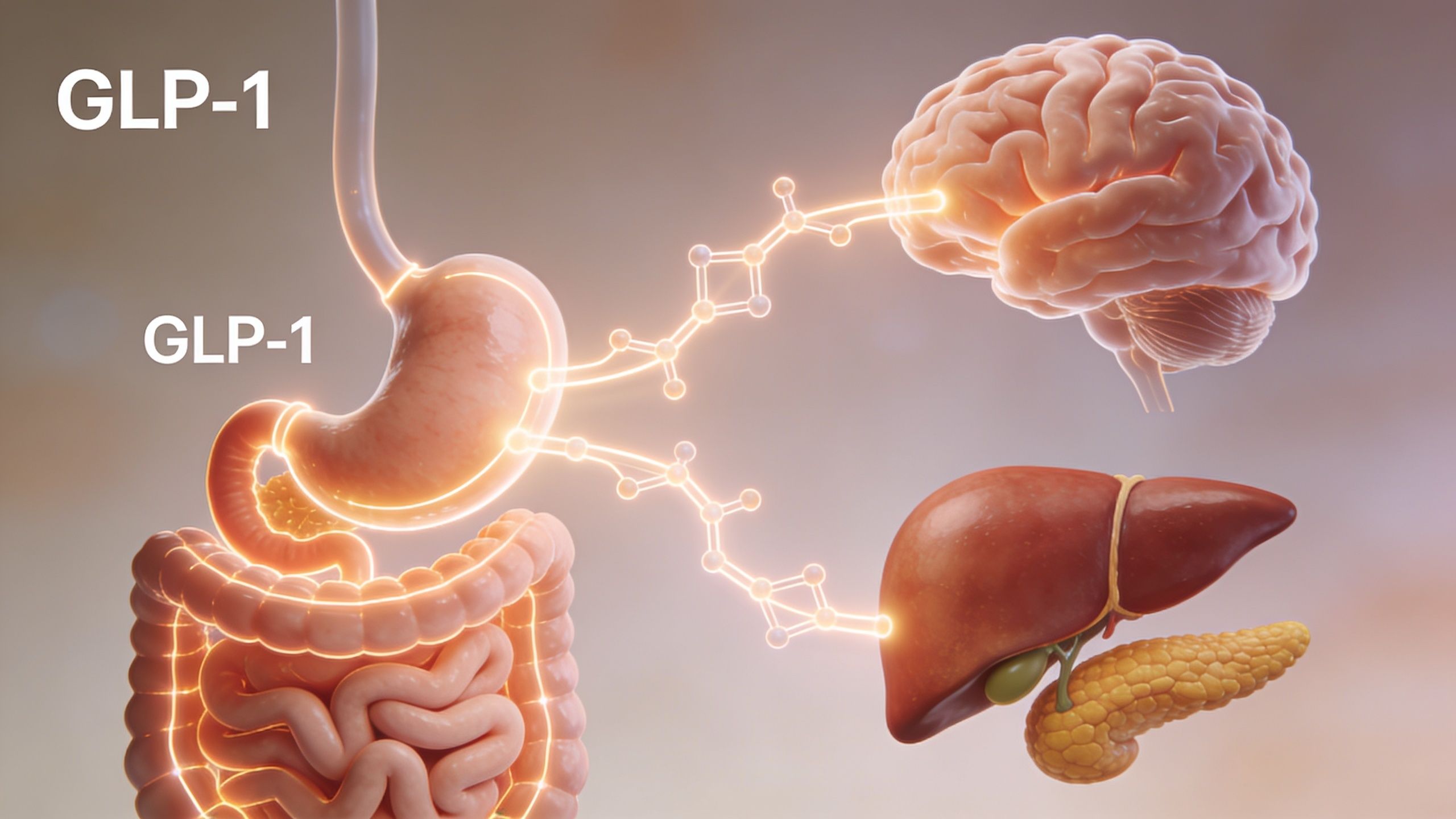
GLP-1 is a gut-derived hormone involved in appetite regulation, gastric emptying, and insulin response. When people say a product “boosts GLP-1,” they’re usually referring to one of two very different things. A drug may directly act on the receptor. A supplement may only nudge upstream processes that influence the broader pathway.
That difference explains most of the confusion in this market. A prescription agonist is designed to produce a strong, sustained physiologic effect. A supplement is usually attempting indirect support through mechanisms such as AMPK activation, digestive slowing, or changes in post-meal signaling.
For anyone comparing options, the most practical rule is simple. Don’t evaluate a supplement by pharmaceutical expectations. If you want a broader primer on compounds marketed into this category, this GLP supplement overview is useful background, but the evidence hierarchy still matters more than the label.
Why the distinction matters
The phrase “natural Ozempic” is popular because it compresses a complicated biology story into a marketing shortcut. It also obscures the fact that these are not interchangeable interventions.
Supplements may support appetite control or glycemic handling in a mild way. That’s different from producing the degree of weight loss seen with prescription receptor agonists.
For an informed reader, the takeaway isn’t that supplements are useless. It’s that they belong in a different category. They’re best treated as lower-potency tools with narrower evidence, not as substitutes for medications that have been tested in large randomized trials over far longer periods.
Prescription GLP-1 Agonists The Clinical Gold Standard
The supplement market borrows the language of GLP-1. Prescription drugs are where the clinically meaningful weight-loss data sit.
That distinction matters because the effect size is not close. A broad review of GLP-1 agonist evidence summarizes the modern benchmark. In STEP-1, semaglutide 2.4 mg weekly produced mean weight loss of 14.9% at 68 weeks in adults with obesity. The same review places that result against the more modest average losses typically seen with standard diet and exercise programs. That is why these drugs changed obesity treatment rather than joining the long list of appetite-control tools.
How GLP-1 Drugs Work
GLP-1 receptor agonists reduce energy intake through several coordinated effects. They increase satiety, slow gastric emptying, and improve glycemic regulation. For a physique-focused reader, the practical implication is straightforward. Lower appetite can make fat loss easier, but it can also lower protein intake, training fuel, and hydration if the diet is not structured carefully.
Long-term follow-up is one reason this category remains the reference standard. The same clinical review reports that STEP-5 showed sustained semaglutide-associated weight loss at 104 weeks with continued treatment, while placebo participants regained weight. The review also highlights liraglutide data from SCALE, where one-third of patients lost 10% of body weight at 1 year, with maintenance extending into longer follow-up, and notes that gastrointestinal side effects can drive discontinuation rates high enough to matter in real practice.
The non-obvious point is that efficacy and tolerability are linked. The same appetite suppression that improves adherence to a calorie deficit can also reduce food variety, total intake, and training quality if side effects are not managed.
Why tirzepatide changed the benchmark
Semaglutide established a high bar. Tirzepatide raised it further. In a benchmark discussion of tirzepatide and semaglutide, SURMOUNT-1 is cited for mean body weight reduction up to 22.5% over 72 weeks with tirzepatide, compared with the 14.9% result reported for semaglutide in STEP-1.
That gap is biologically plausible. Tirzepatide activates both GIP and GLP-1 pathways, which appears to strengthen appetite control and metabolic effects beyond GLP-1 agonism alone. For informed readers comparing drugs with supplements, this is the key efficiency gap. Even the strongest supplement data usually point to incremental support. These medications produce double-digit percentage weight loss in large trials.
Here’s a useful explainer before going further:
Body composition still depends on execution. The same tirzepatide discussion highlights higher protein intake and resistance training as relevant for lean-mass retention, and notes that fat-free mass losses compared favorably with diet-only settings. That does not mean the drug preserves muscle on its own. It means the medication changes appetite and body weight, while training and nutrition still determine how much of that loss comes from fat versus lean tissue.
If you follow this category closely, this GLP-1 agonist coverage hub is a practical way to track new approvals, trial data, and clinical use patterns.
Evaluating Natural GLP-1 Supplements
Natural GLP-1 supplements are usually marketed as if they sit on the same continuum as semaglutide or tirzepatide. The evidence does not support that framing. What the better data suggest is a narrower role: modest support for appetite regulation, glycemic control, or satiety in some people, with far smaller and less predictable effects on body weight.
That distinction matters because this category gets blurred constantly. Prescription GLP-1 agonists were built to activate incretin signaling directly. Supplements do not do that. At best, they may influence upstream pathways linked to endogenous GLP-1 release, gastric emptying, insulin sensitivity, or food intake. The practical implication is simple. A useful supplement can still be worth using, but it should be chosen as supportive nutrition, not as a pharmaceutical stand-in.
One review commonly cited in consumer content on natural GLP-1 support groups the leading candidates as berberine, curcumin, green tea extract, and ginger, with the strongest overall support going to berberine and more limited adjunctive support for the others, as summarized in this review of natural GLP-1 supplements.
Berberine has the strongest non-prescription case
If one supplement deserves serious attention in this category, it is berberine.
Its appeal is mechanistic and clinical. Berberine has been studied for effects on AMPK signaling, insulin sensitivity, and glucose metabolism, which gives it a more plausible metabolic rationale than many appetite products sold under a “GLP-1” label. The weight-loss effect is still modest, but at least there is a real evidence base behind it. The commonly cited dosing range is 1000 to 1500 mg per day, and the expected outcome is incremental fat-loss support rather than dramatic scale change.
That puts berberine in a specific lane. It may fit for lifters, dieters, or metabolically at-risk adults who want a non-prescription tool with better backing than generic appetite suppressants. It does not belong in the same expectation category as a prescription incretin drug.
Practical rule: Use berberine if your goal is modest support with some clinical rationale. Do not use it as a substitute for drug-level efficacy.
Product quality also matters more here than brand storytelling. Dose, contamination risk, and third-party testing determine whether you are buying a compound with a plausible chance of matching the studied material. This guide on how to tell if a supplement is legit is more useful than influencer rankings or “doctor formulated” label claims.
Curcumin, EGCG, and ginger are adjuncts, not primary tools
Curcumin is easier to overstate than to justify. It has some rationale for metabolic support and may affect post-meal GLP-1 responses, especially when paired with an absorption aid such as piperine, but the evidence for meaningful standalone weight loss is weak. For a serious cutting phase, curcumin makes more sense as a background support compound than as the center of a fat-loss stack.
Green tea extract, usually framed around EGCG, has a somewhat stronger use case. It has been linked to acute changes in GLP-1 response and may modestly support fat loss or energy balance in some settings. Even so, the effect size remains limited. For trained readers used to interpreting intervention data, EGCG looks like a mild adjunct with a measurable signal, not a category leader.
Ginger is the least compelling option if the target outcome is body-weight reduction. Its value is more indirect. By influencing gastric emptying, digestive comfort, and fullness, it may help some people with meal pacing and appetite control. That is a reasonable use case. It is not evidence that ginger functions as a meaningful GLP-1 substitute.
Evidence Profile of Top Natural GLP-1 Supplements
| Supplement | Proposed Mechanism | Evidence-Based Daily Dose | Expected Weight Loss (12 Weeks) |
|---|---|---|---|
| Berberine | AMPK activation with increased GLP-1 secretion | 1000-1500 mg/day | 2-5% |
| Curcumin | Post-meal GLP-1 elevation, usually with absorption support | 1 g/day | Mild support, not clearly established as primary driver |
| Green Tea EGCG | Acute GLP-1 elevation and metabolic support | 300 mg/day | 3.5% |
| Ginger | Slows gastric emptying and may improve fullness | 2 g/day | Qualitative support only |
A clearer way to rank these supplements is by expected job, not by marketing intensity.
- Berberine: strongest evidence among non-prescription options, still modest in outcome
- EGCG: reasonable adjunct for appetite or energy-balance support
- Curcumin: metabolic support with limited value as a primary fat-loss tool
- Ginger: satiety and digestive support, mainly useful as an adjunct
The main analytical mistake in this category is assuming several mild compounds can be stacked into something that behaves like a GLP-1 agonist. Current evidence does not justify that conclusion. Stacking may increase cost and side-effect burden faster than it improves results.
Comparing Efficacy Safety and Accessibility
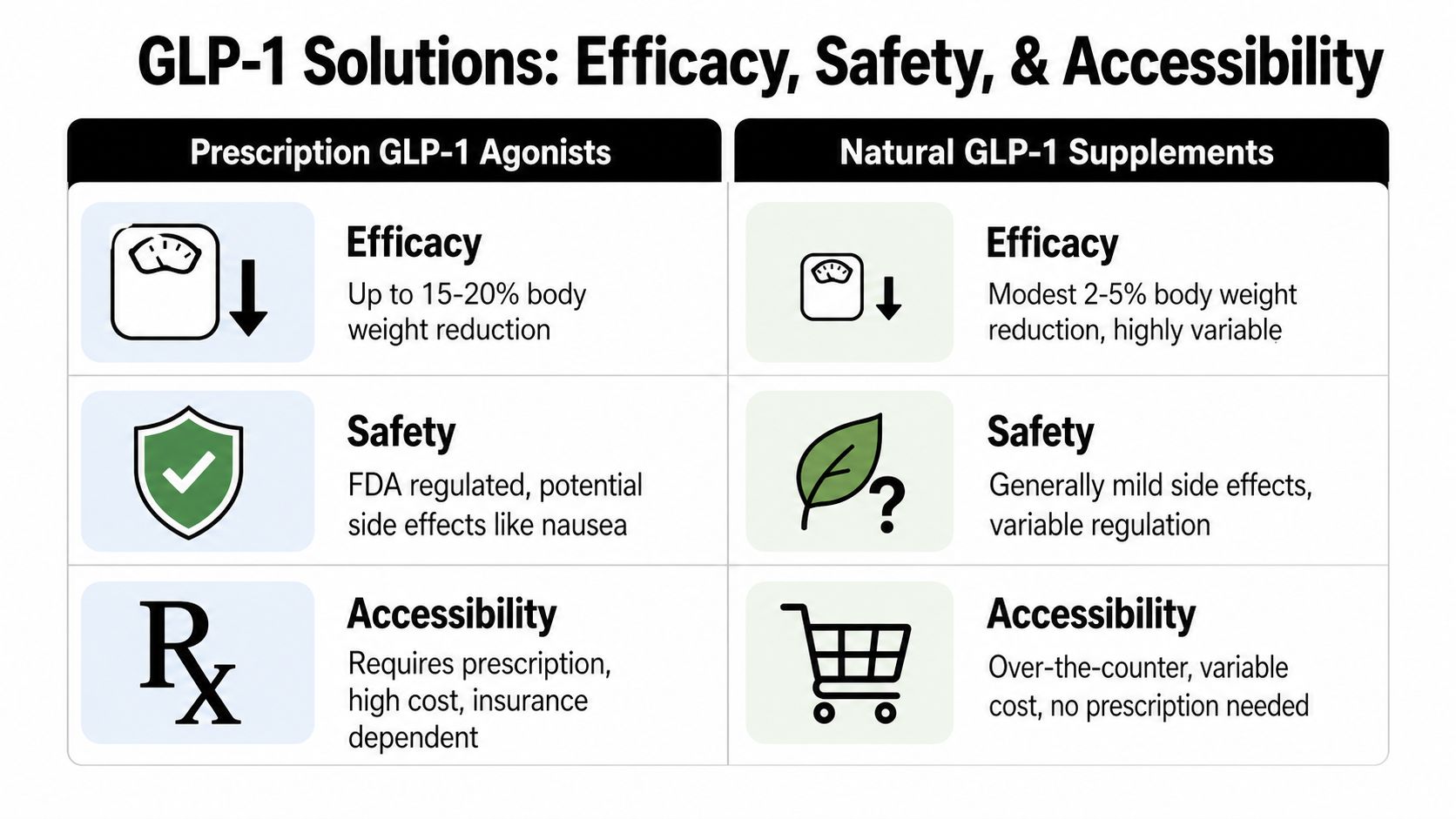
The key comparison is not between one supplement and another. It is between a regulated obesity treatment with large clinical effects and a group of adjuncts that may modestly support appetite, glycemic control, or adherence.
Where supplements fit and where they don’t
The efficacy gap matters because it changes the whole decision process. As noted in the clinical review cited earlier, semaglutide produced far larger average weight loss than any over-the-counter ingredient discussed in this guide. Berberine remains the strongest non-prescription option in practical terms, but its expected effect is still modest and should be framed as support, not replacement.
That distinction gets blurred in marketing.
A product can reference GLP-1 signaling, satiety hormones, or post-meal glucose control and still fall far short of the effect size seen with prescription agonists. For an informed buyer, mechanism is only the starting point. The harder question is whether that mechanism translates into clinically meaningful fat loss at realistic doses and over a useful time horizon.
Safety is less simple than "drug equals risky, supplement equals safe." Prescription GLP-1 agonists have well-characterized adverse effects, clear dosing, and physician oversight. Supplements usually have easier tolerability profiles, but they also face bigger quality-control variation, weaker long-term outcome data, and more uncertainty around what is in the bottle. For athletes and physique-focused dieters, that uncertainty can affect both results and side-effect management.
Accessibility shifts the balance in the opposite direction. Supplements are easier to buy, cheaper at the entry point, and available to people who do not qualify for or do not want medical treatment. That makes them relevant. It does not make them equivalent.
The decision framework for athletes
The practical question is what problem you are trying to solve.
Use prescription therapy if the target is the highest probability of substantial body-weight reduction and you are prepared for medical screening, dose escalation, side effects, and ongoing supervision.
Use berberine-first supplementation if you want a lower-barrier option and accept a smaller expected payoff.
Use lower-evidence adjuncts if appetite control, digestive comfort, or meal adherence is the bottleneck, not major weight reduction.
Avoid treating a supplement stack as a stand-in for a medication just because both are discussed under the GLP-1 label. Similar terminology does not mean similar efficacy.
If you want an example of how this category gets overstated, this analysis of GLP Activate claims shows why label language and mechanism-based marketing deserve close scrutiny.
Protocol for Nutritional Support and Muscle Preservation
The biggest error on any GLP-1 pathway is assuming appetite suppression automatically improves body composition. It often lowers food intake faster than it improves diet quality. For lifters, that creates a predictable failure mode: scale weight falls while training performance, recovery, and lean mass drift in the wrong direction.
Bloodwork before adding more pills
Reduced intake changes more than calories. It can also reduce intake of protein, electrolytes, and several micronutrients that affect training quality and fatigue. A tired athlete may blame the drug, the calorie deficit, or overreaching when the immediate issue is low intake plus an uncorrected deficiency.
Blood panels help separate those problems. This nutritional support overview for GLP-1 users highlights common areas of concern such as vitamin D, B12, and magnesium status, with attention to serum magnesium below 1.8 mg/dL.
A practical approach is straightforward:
- Get baseline labs before an aggressive diet phase or before starting a medication that is likely to suppress appetite.
- Recheck after intake drops if food volume, meal frequency, or exercise tolerance changes.
- Correct the actual deficit instead of adding a generic “GLP support” stack that may not address the limiting factor.
This matters more than supplement marketing. If magnesium is low, magnesium is the intervention. If B12 is low, B12 is the intervention.
The role of protein and training
Clinical weight-loss results are often discussed in terms of total pounds lost. Athletes should read them through a different lens: how much of that loss came from fat mass versus lean tissue. That is where nutrition and training determine whether a successful cut also preserves performance.
The practical target is to keep protein intake high enough to defend lean mass while maintaining a resistance-training stimulus. The review cited earlier described 1.3 g/kg as a high-protein approach during therapy, and the tirzepatide discussion referenced above emphasized 1.5 g/kg for users prioritizing body composition.
That makes meal structure more important, not less. A high-protein diet framework is usually more useful here than adding another fat-loss supplement, especially when appetite is low and total food volume is harder to tolerate.
Use these priorities to keep the plan functional:
- Set protein first, then distribute it across meals you can reliably finish.
- Keep resistance training in place, because muscle retention depends on continued mechanical tension.
- Reduce meal complexity if appetite suppression makes large or varied meals harder to complete.
- Monitor GI tolerance, since high fiber intakes, stimulant-heavy pre-workouts, and bulky supplement stacks can become less tolerable when gastric emptying slows.
The point is simple. Prescription GLP-1 drugs can produce clinically meaningful weight loss. Supplements may offer modest support. Neither protects muscle by itself. Protein intake, resistance training, and correction of real deficiencies do that work.
Frequently Asked Questions About GLP-1 Supplements
Can you stack natural GLP-1 supplements
You can, but “can” isn’t the same as “should.” Berberine, curcumin, EGCG, and ginger each have different rationale, yet there’s still a major evidence gap around how these stacks perform over time, especially for resistance-trained people. A review focused on the long-term uncertainty of natural GLP-1 supplements notes that most supplement studies are short-term, often 3-6 months, and don’t answer the bigger question serious athletes care about, which is sustained efficacy and safety.
Do natural GLP-1 supplements need to be cycled
There isn’t strong evidence establishing a cycling protocol for this category. In practice, tolerance, digestive comfort, and lab work matter more than arbitrary on-off schedules. If a compound worsens GI symptoms or interferes with eating enough protein, the protocol needs adjustment even if the label says it supports metabolism.
How long does it take to see results
Supplements and prescription drugs shouldn’t be judged on the same timeline or standard. Berberine data is typically discussed over 12 weeks in the evidence cited earlier, while the major prescription trials run far longer. If you’re expecting rapid, drug-like body composition changes from supplements alone, you’re likely setting the wrong target.
Are these safe with pre-workouts or fat burners
Sometimes, but there’s no universal yes. The biggest practical issue is overlap in GI stress, appetite suppression, and total stimulant load. Athletes often make a stack harder to tolerate by combining too many “cutting” products at once.
What’s the best glp 1 supplements for weight loss for most people
For non-prescription use, berberine has the strongest case. EGCG and curcumin are better seen as secondary tools. If your goal is substantial weight loss and you qualify medically, prescription therapy remains the evidence leader. If your goal is modest support, supplements may fit. The mistake is pretending those two paths are interchangeable.
If you want no-hype breakdowns of supplements, recovery tools, diagnostics, and performance strategies, RxGainz is built for that kind of reader. It’s a solid place to compare claims against actual evidence before you spend money or build a new protocol.
